MACHINE LEARNING
SteamWise Predict
Enter boiler-plant measurements. Explore the classification predicted by a genuinely trained 100-tree Random Forest, with model probabilities and range checks.
Try fault prediction ↗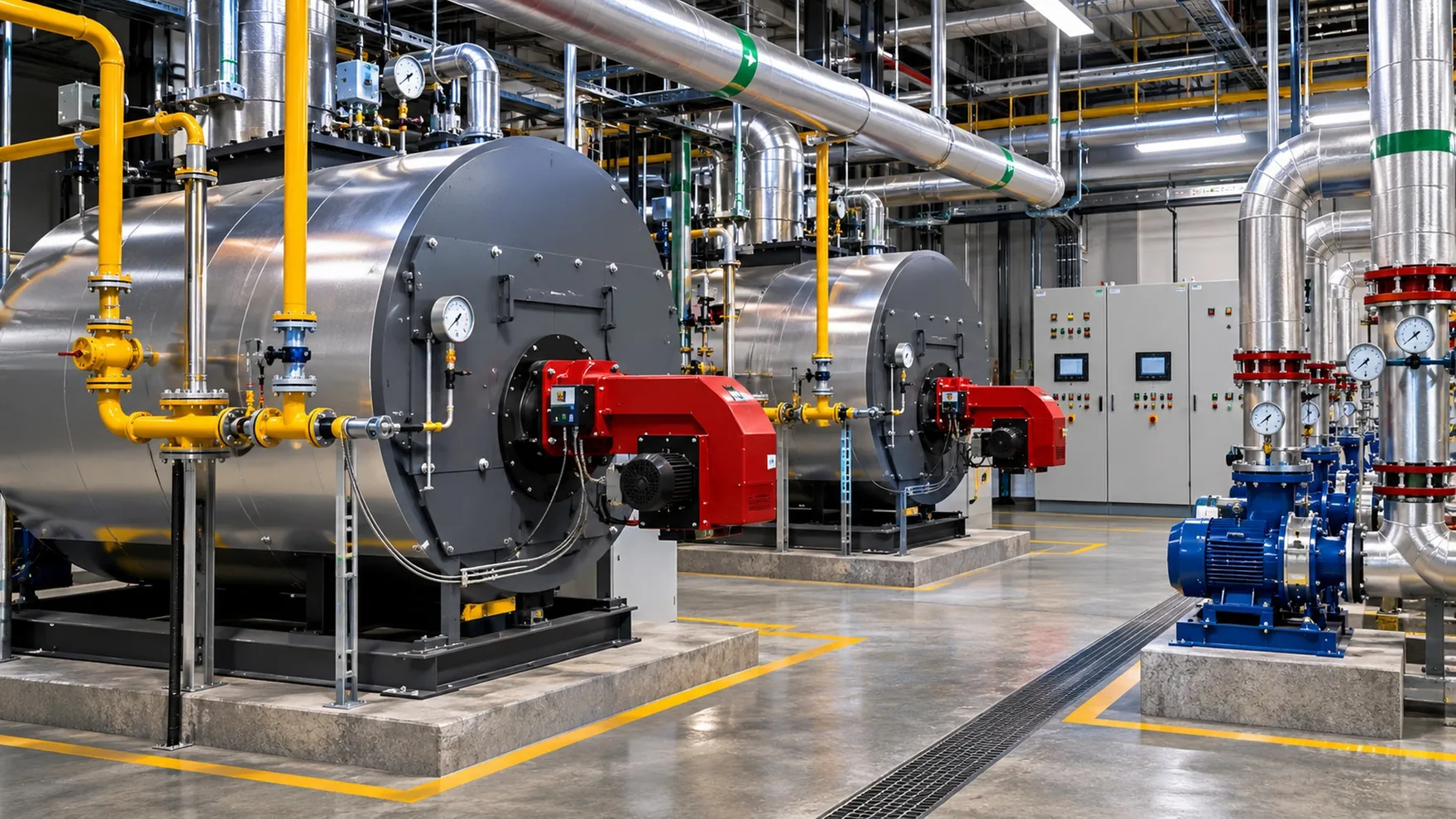
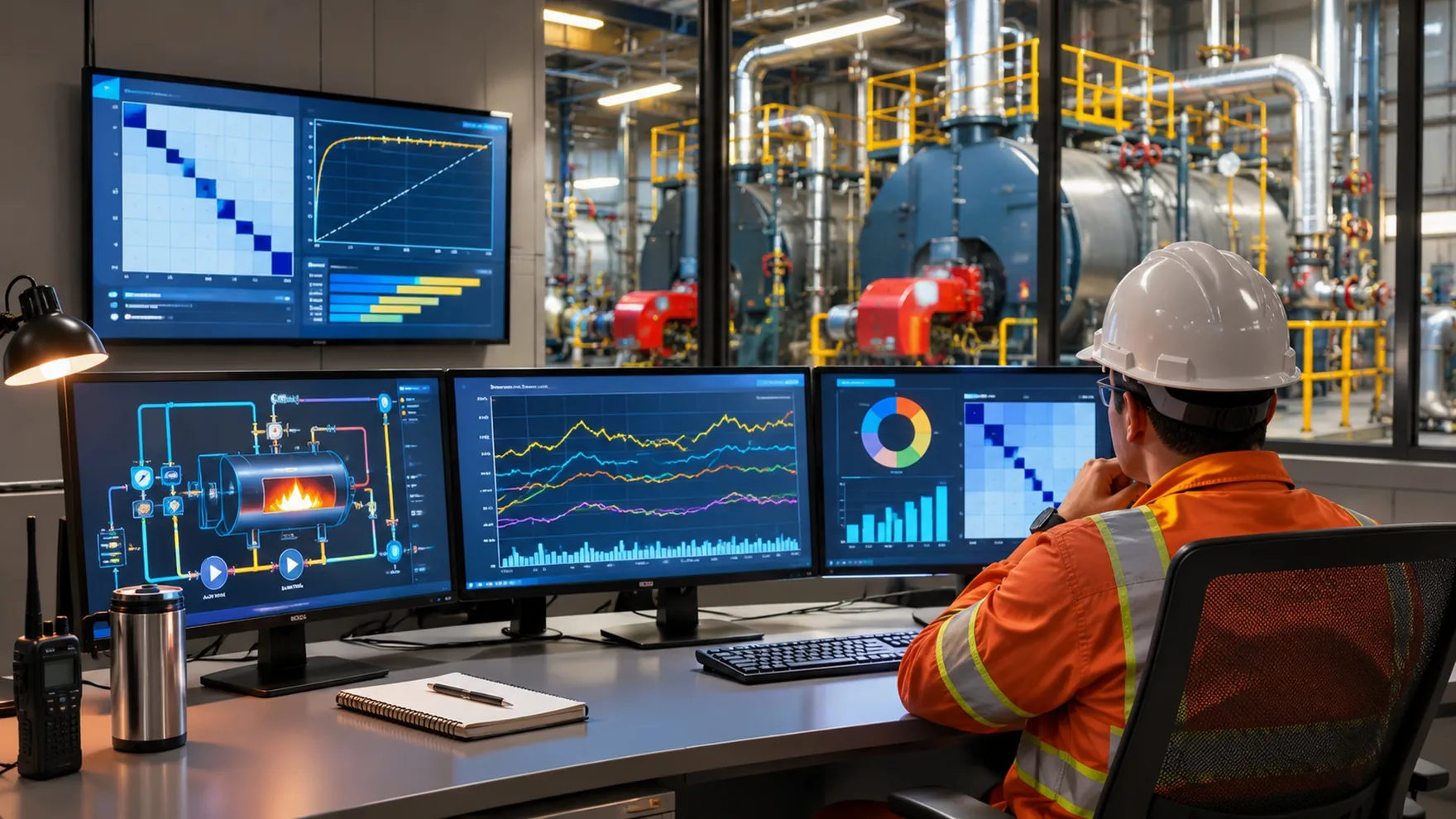
Every building has a story hidden in its operating data. SteamWise AI explores how we can make that story easier to understand—and how responsible machine learning could help us listen.
01 / THE REASON
Boilers, pumps and sensors generate signals continuously. Weather, occupancy and heating loads change what “normal” looks like. The opportunity is to combine operating evidence with sound engineering judgment—not replace it.
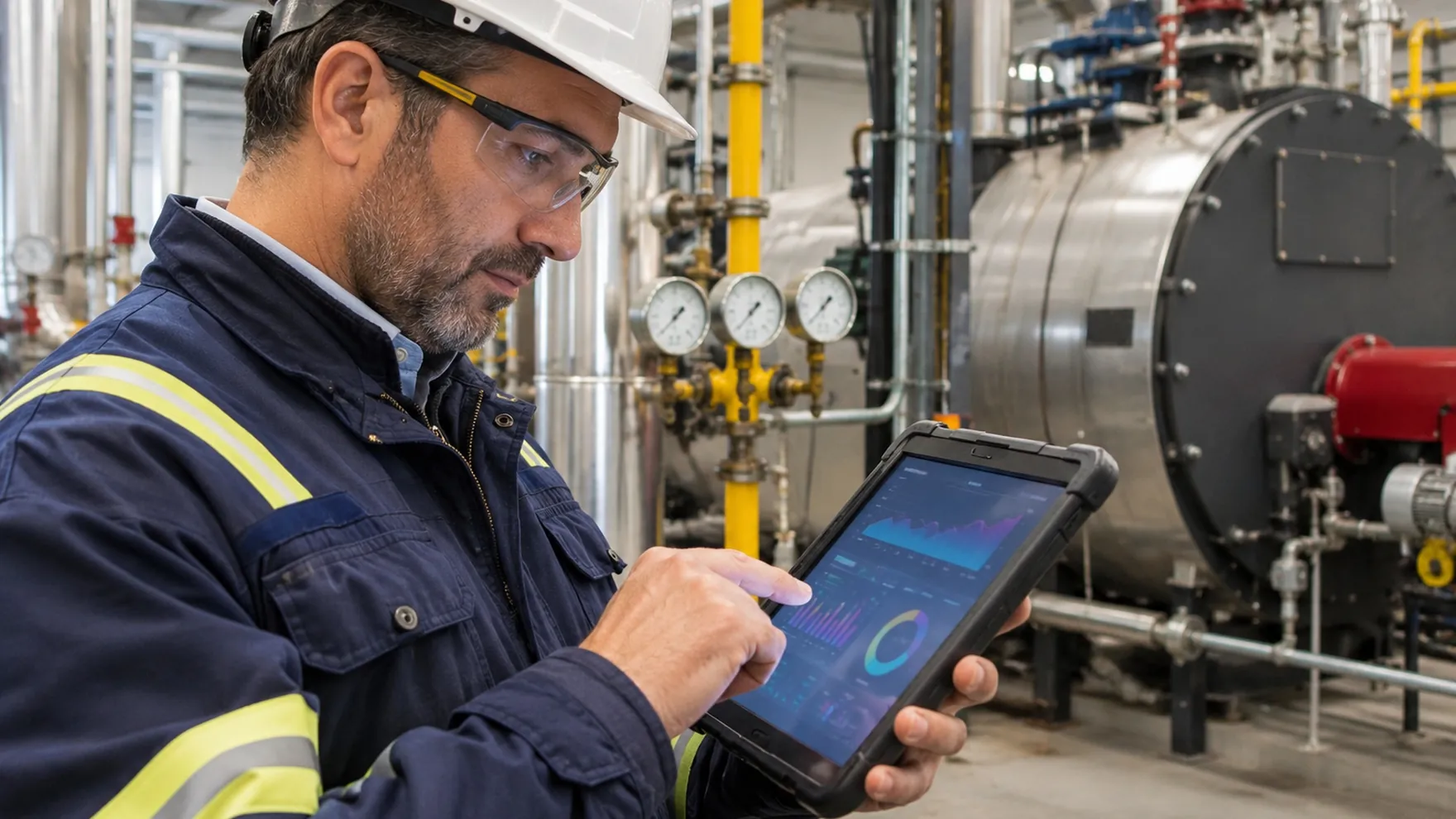 Where engineering meets data
That is the technical question behind SteamWise AI—and the reason external validation matters.
02 / TWO WORKING EXPERIENCES
Enter boiler-plant measurements. Explore the classification predicted by a genuinely trained 100-tree Random Forest, with model probabilities and range checks.
Try fault prediction ↗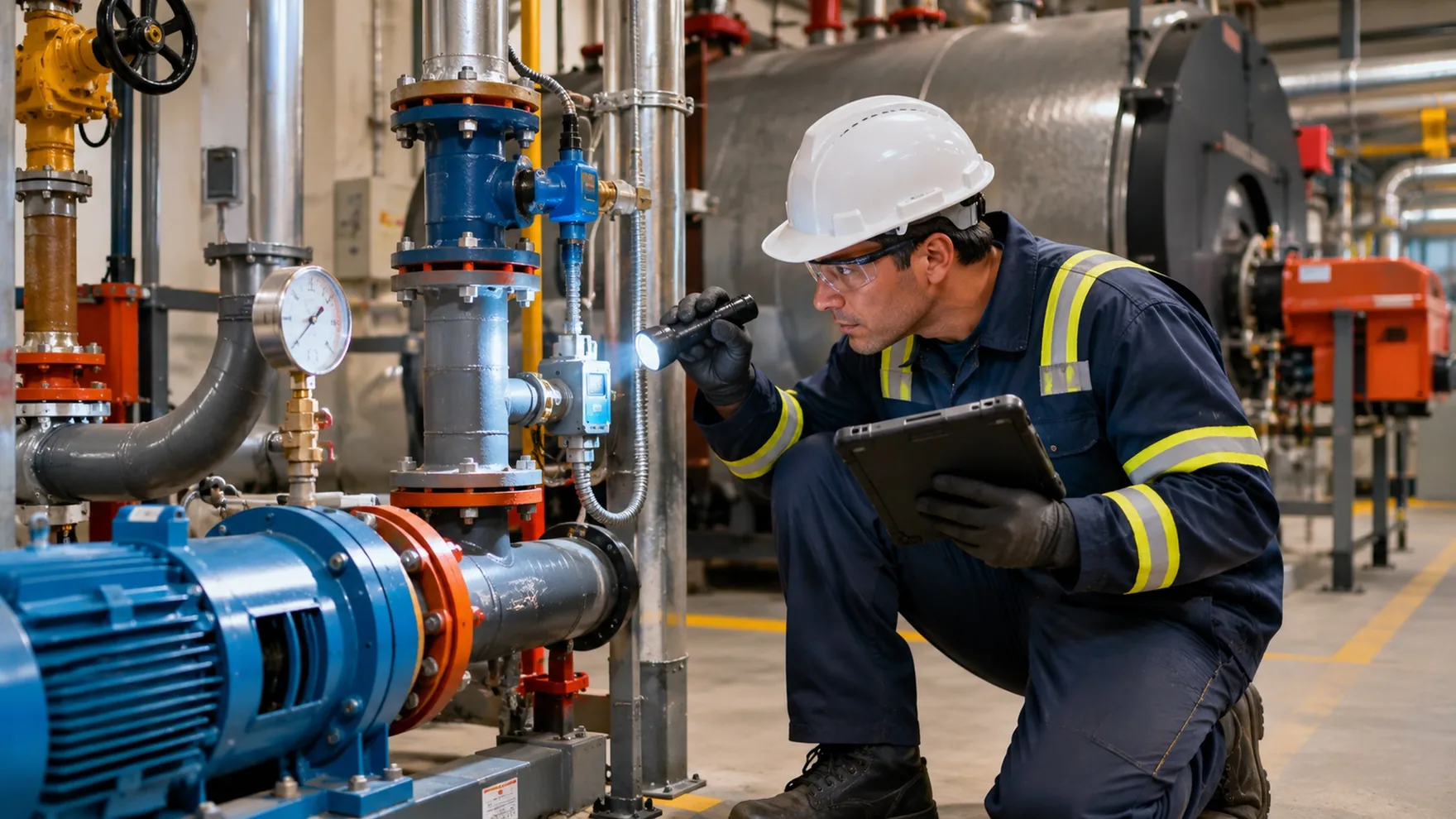
See how a component photograph can become an interactive Power Engineering lesson—with identification cues, safety learning notes and syllabus links.
Launch Vision ↗03 / THE SURPRISE
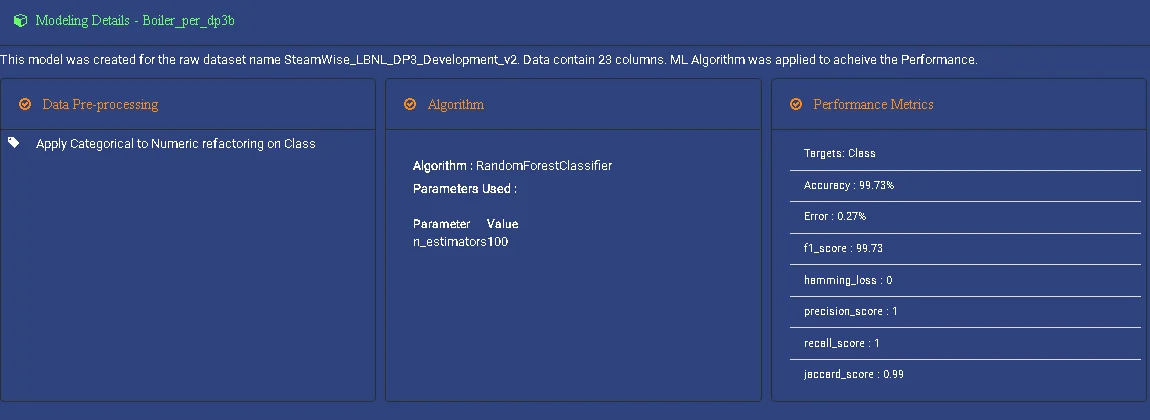
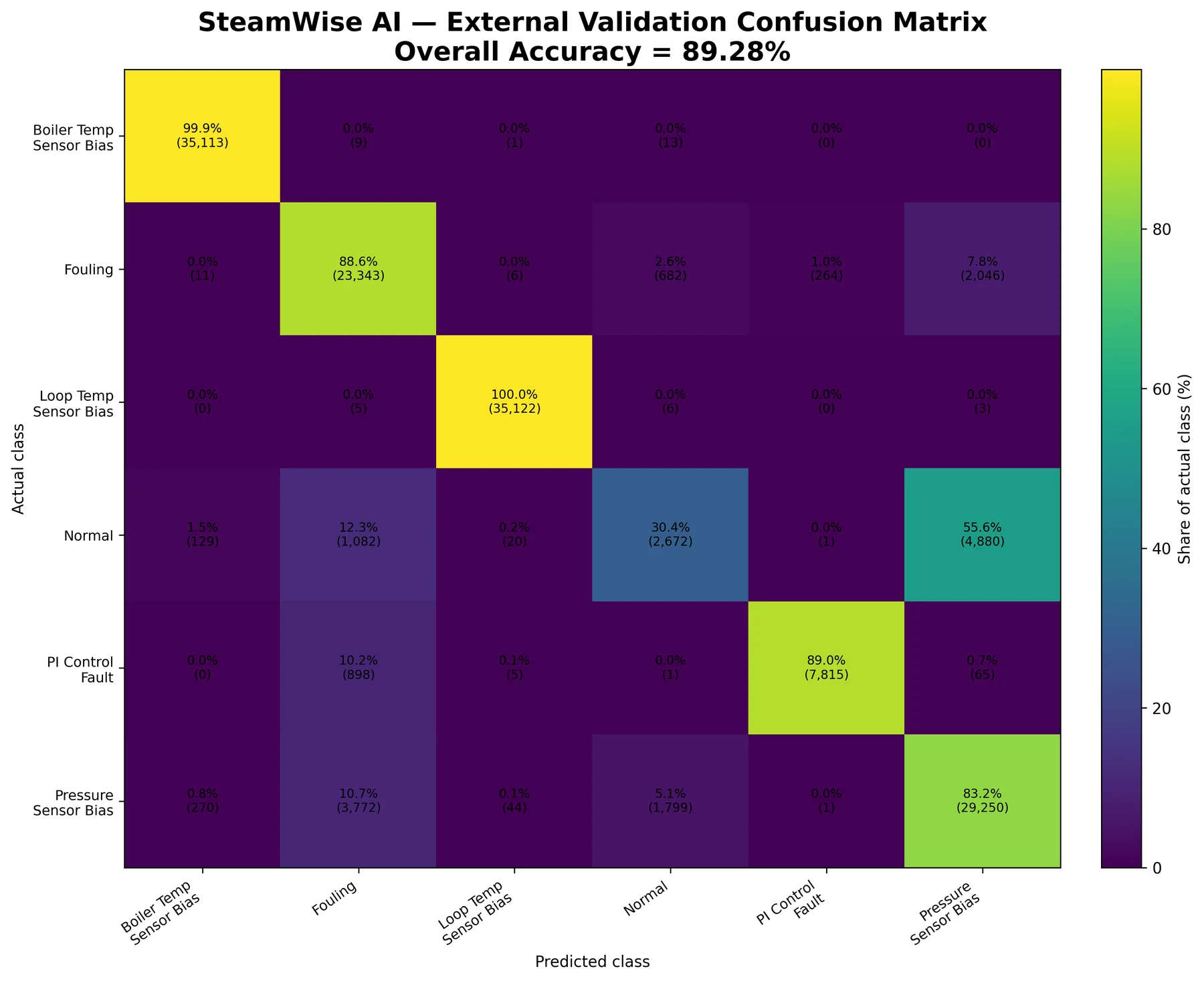
Our final DP3 model posted 99.73% on an internal random split. When challenged against a separate simulated operating period, the score was materially lower. That gap became the most valuable result of the project.
And for Normal operation, external recall was only 30.42%. A headline metric cannot tell the whole story.
Investigate what changed ↗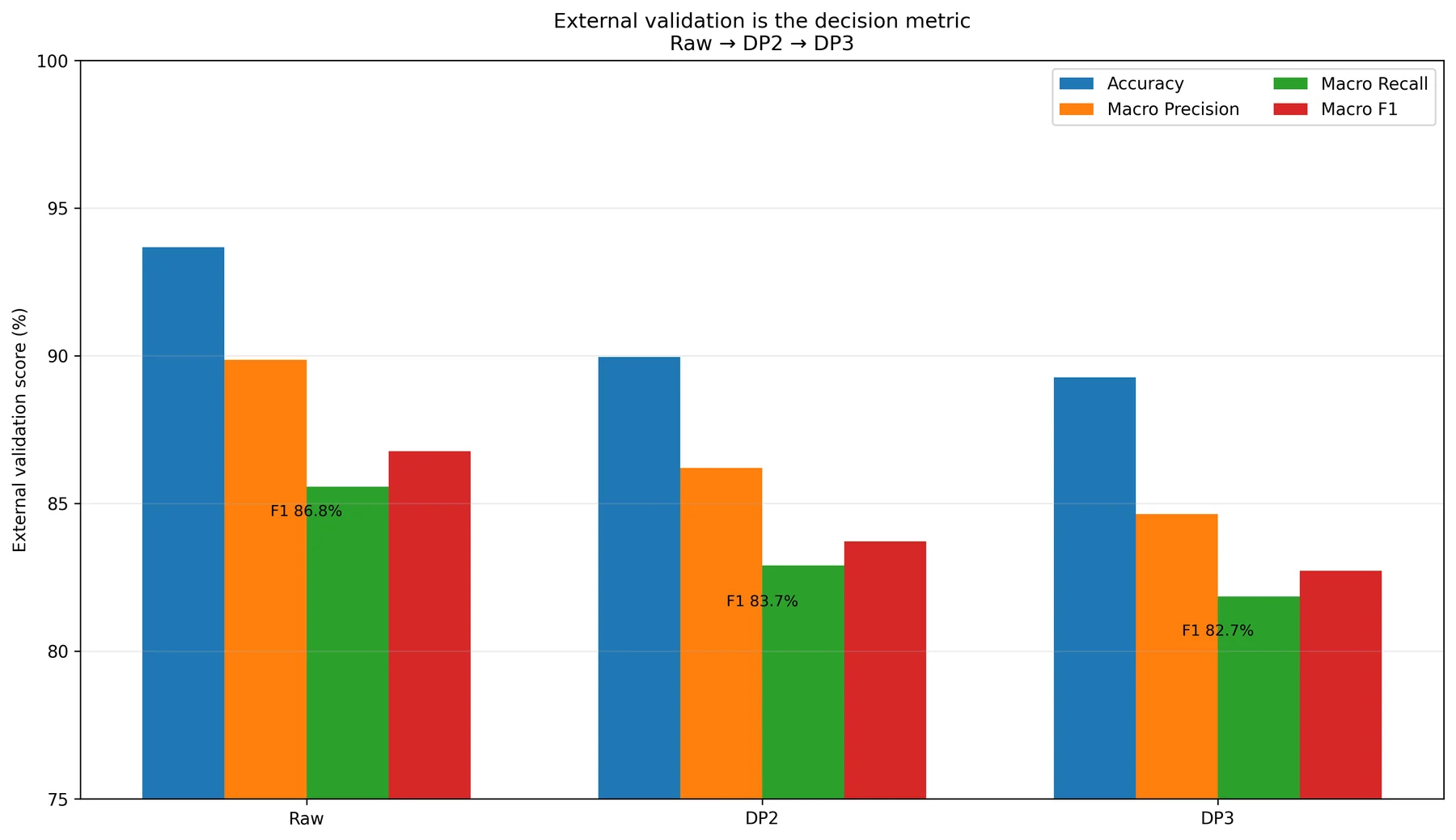
04 / A BIGGER IDEA
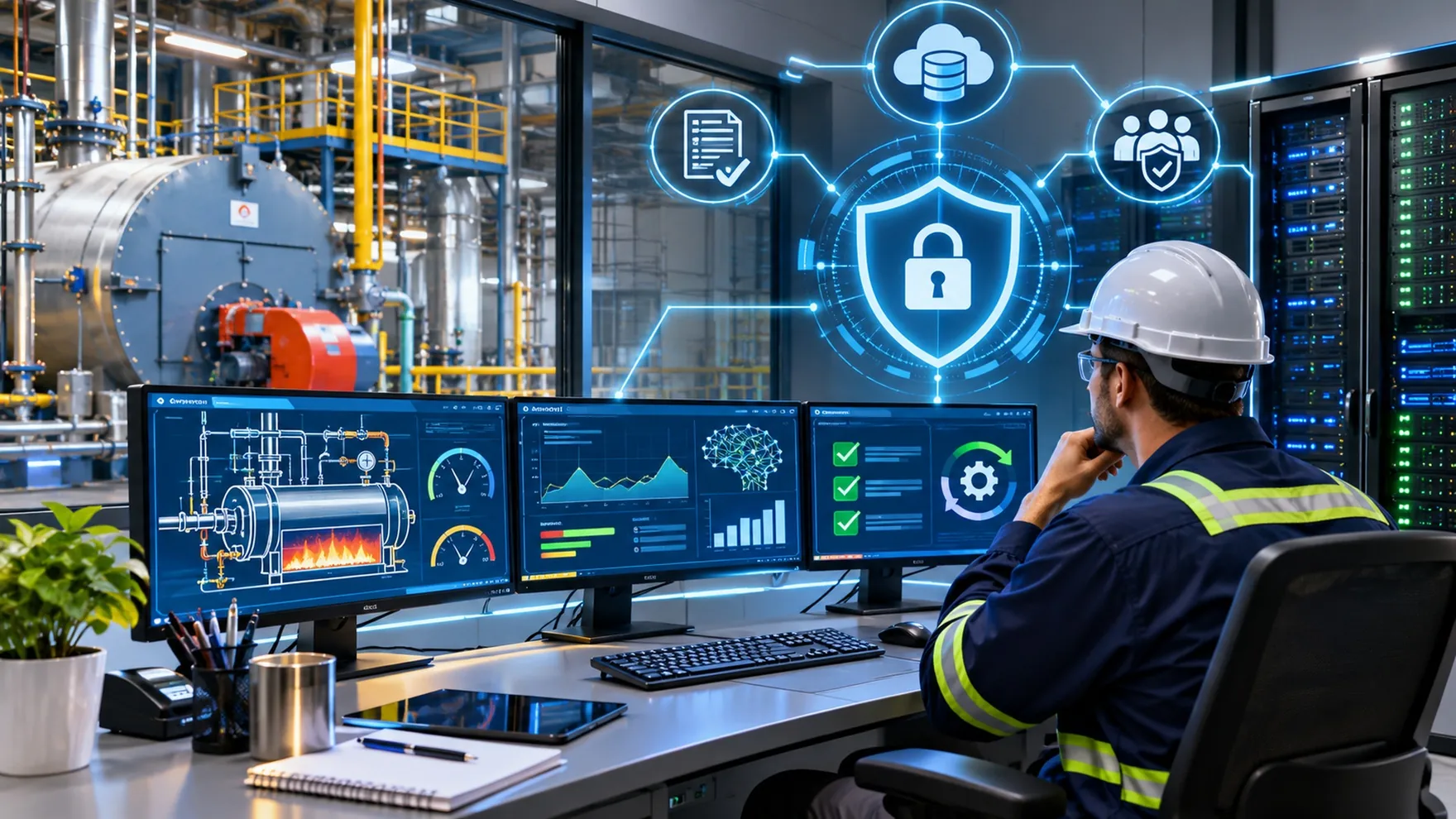
Imagine a future owner-specific system that learns from authorized building measurements, flags patterns for professional review, and adapts through supervised monitoring and controlled retraining.
Then connect that diagnostic capability to visual equipment education and, one day, an interactive Virtual Boiler Simulator.
05 / PURPOSEFUL IMPACT
Explore the potential for more informed energy management and efficient operation.
Support thoughtful resource use, equipment understanding and maintenance decisions.
These are prospective contributions, not demonstrated energy, cost or emissions savings.
Twelve questions. Six simulated operating conditions. Two data populations. One place to explore the evidence for yourself.
THE ORIGINAL INVESTIGATION
The source dataset models two boilers and two circulating pumps serving a simulated 12-storey Chicago office building. This original project screenshot preserves the exploratory context.
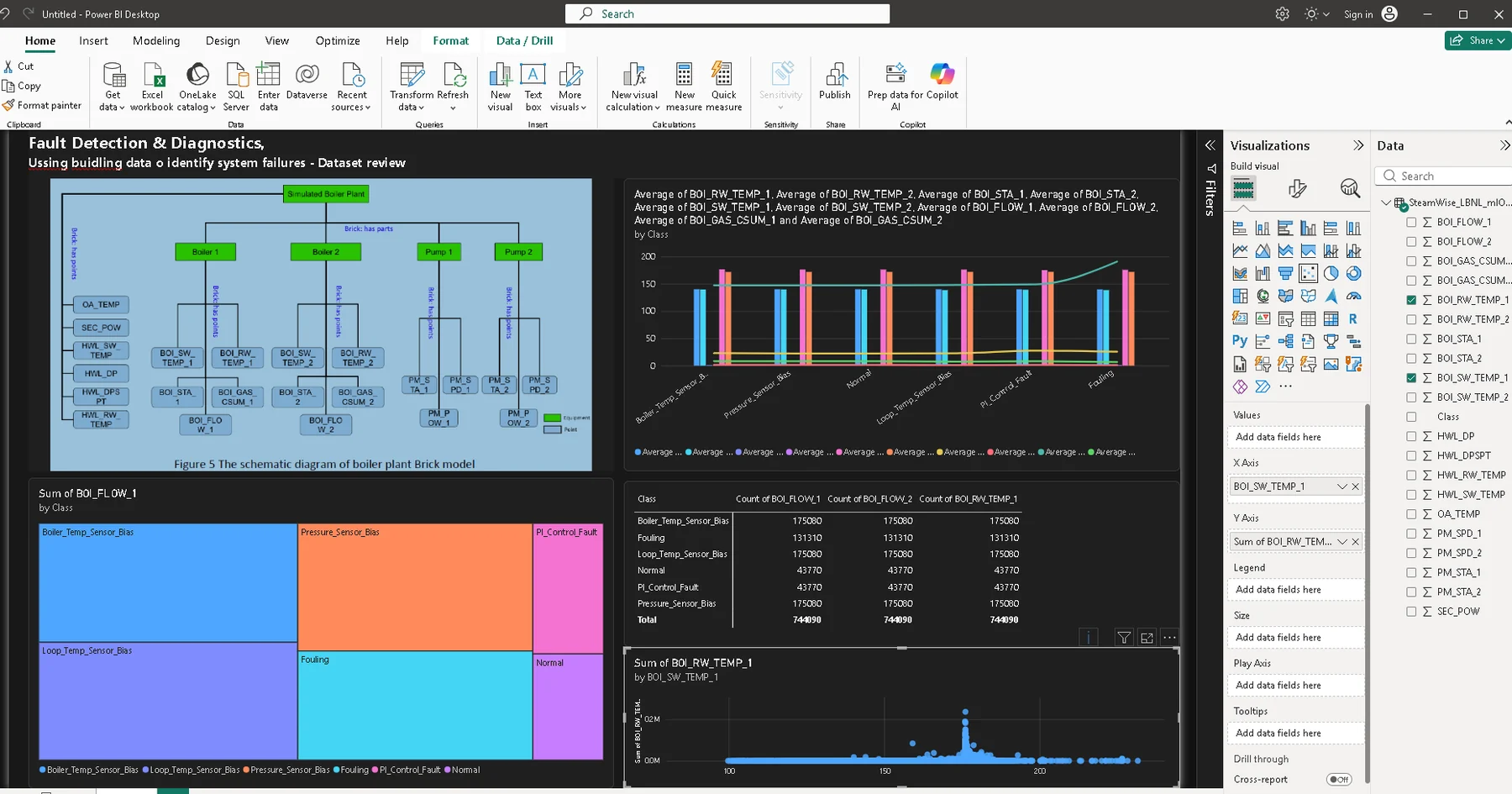
Temperatures, pressure, flow, gas and equipment states only make sense in the context of the plant.
Imbalanced conditions, repeated readings and near-constant signals require deliberate preparation.
Simulated scenarios provide a controlled benchmark—not proof of real building performance.
INTERACTIVE ANALYTICS LAB
Every chart below uses source-backed aggregates or clearly identified sampled observations. Hover, filter, zoom and export chart images.
WHAT COMES NEXT
EDA revealed why a robust data audit is essential before modelling—and why highly correlated simulation features can create misleading confidence.
Follow the ML pipeline ↗Seven steps in an applied research journey: more questions, better data understanding, and a hard-earned respect for independent evaluation.
THE PIPELINE
20 candidate predictors after excluding problematic pump-power signals.
Missingness, repeated states, class balance, unusual values and potential shortcuts.
Remove two constants and an almost-constant setpoint; retain 17 predictors.
Add three ΔT features, combined boiler flow and combined gas input.
RandomForestClassifier, 100 trees, six operating categories.
Evaluate against 149,328 independent Nov–Dec simulation records.
Investigate normal-class recall, confusion pairs, bias and deployment limits.
THE EXPERIMENT
Raw achieved the strongest external numerical score, but retained possible simulation shortcut behaviour. Physically meaningful DP3 features improved interpretability without improving temporal verification accuracy.
Accuracy
Accuracy
Accuracy
Random 80/20 accuracy
Against genuinely later simulated data, the model's results were weaker than its internal random-split performance suggested.
Accuracy alone also hid an important weakness: DP3 recognized only 30.42% of actual Normal observations.
Explore all external metrics ↗PRIMARY EVIDENCE
ENGINEERING INTERPRETATION
Feature engineering makes a model more interpretable, but operational change, label imbalance and possible simulation artifacts can still undermine generalization.
Next research priorities include time-aware cross-validation, investigation of shortcut predictors, improved Normal recognition and fault-onset labels suitable for actual early-warning evaluation.
Try the real model ↗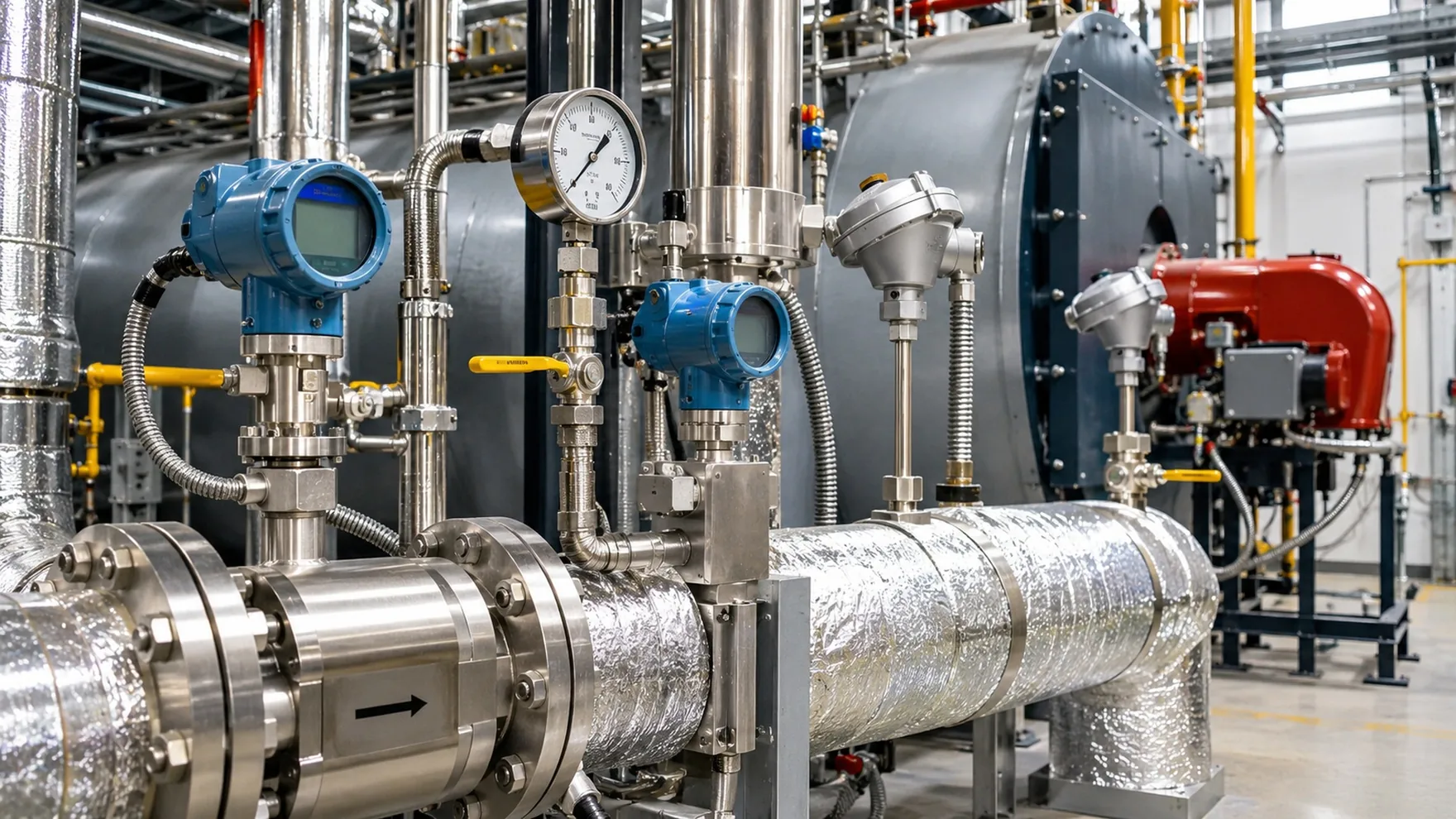
One system interprets operating measurements. Another helps students explore equipment through images. Both require informed human judgment.
01 / STEAMWISE PREDICT
Submit 17 simulated-process measurements. The server calculates five engineering features and returns an actual prediction from a trained 100-tree Random Forest.
Choose a sample state, modify any variables and select Analyze operating pattern.
Portable DP3 deployment model, separately trained from academic mlOS. Independent verification: 89.48% accuracy and 82.96% macro F1 on 149,328 simulated observations.
02 / STEAMWISE VISION
A separate Google AI Studio multimodal prototype helps students connect equipment photographs with Power Engineering knowledge, visual identification cues and safety-learning notes.
Explore low-water fuel cut-off devices, pressure gauges and component functions. Visual recognition is educational; it does not confirm equipment condition.
Launch SteamWise Vision ↗Google AI Studio may require sign-in. Do not submit sensitive facility or personnel images without authorization.
Explore equipment identification, a protective function and its difference from routine feedwater control.
Explore in SteamWise Vision ↗Explore local indication and how it differs from automatic pressure control and independent protection.
Explore in SteamWise Vision ↗03 / THE FUTURE
A future simulator could combine engineering-based scenarios, machine-learning explanations and visual component education. This is a concept—not a completed or certified operator-training system.
Explore fictional plant operating changes in a controlled environment.
Compare physical cause-and-effect with data-driven classification.
Understand equipment, protective functions and evidence-based decisions.
Watch, read, inspect, download and interact. A curated evidence shelf for industry, education and technical reviewers.
NOTEBOOKLM VIDEO / PUBLISH-READY SLOT
The NotebookLM executive video is currently in preparation. This section is fully designed for either direct MP4 upload or a public, embeddable video URL.
STEAMWISE AI · VIDEO OVERVIEW
Video embedding never relies on a fake preview. If an external host blocks embedding, the website will show a verified "Watch video" button instead.
DOWNLOAD & EXPLORE
The complete project story, methodology, results and responsible AI framework.
Download Word ↗02 / VIEW12-slide story for industry and policy stakeholders.
View PDF ↗03 / PRESENTOriginal presentation assets ready for PowerPoint.
Download PPTX ↗04 / EXPLOREFive executive and seven advanced questions, backed by the project data.
Open dashboard ↗05 / DOWNLOADOriginal 300-dpi research graphics with source-driven comparisons.
Download ZIP ↗06 / AUDITExtended project compendium and technical context.
Download Word ↗07 / SOURCEOriginal simulated boiler plant dataset and documentation, DOI 10.25984/1881324.
Open official source ↗08 / TRYMultimodal component-identification and Power Engineering study prototype.
Launch Vision ↗09 / RUNActual server-based trained model inference, with warnings and plain explanations.
Explore predictions ↗ASK THE PROJECT
The Jotform AI assistant is connected to the project knowledge base. It can help navigate concepts, figures and resources; verify important answers against primary evidence.
Try: "Why did DP3 accuracy decrease during temporal validation?"
Or open full-screen ↗The chatbot is provided by a third party. Clicking “Embed” opens its content within this page and may enable third-party processing.
Prediction quality, privacy, technical boundaries and independent protection belong in the same conversation.
OUR FIRST RULE
SteamWise is a controlled simulation-based research exercise. It has never been qualified for industrial or commercial plant control, failure prevention or safety-critical diagnostics.
Public simulated records only. Future owner-data integrations require permission, controlled access and data-handling agreements.
Keep original data, audit DP1–DP3 operations and verify derived quantities before use.
Show Normal recall and misclassification patterns, not only headline accuracy.
Professional operators and engineers evaluate all physical implications and interventions.
No raw personal data is required by the current prediction engine. Keep backend models and secrets off the public static assets.
Future monitoring must detect operating-data drift, verify changes and enforce human approval of retraining.
DISCLOSURE
CONTROLS ALONG THE PIPELINE
Permission, completeness, provenance and fairness across represented operating states.
Feature integrity, reproducible tests, leakage assessment and per-class evaluation.
Secure access, restricted functionality, transparent uncertainty and professional review.
Ongoing drift checks, incident learning, versioning, audit records and human approval.
The original U.S. DOE dataset is publicly accessible. Check applicable licensing and attribution terms before redistributing original source material. This website links to the authoritative dataset rather than distributing the multi-gigabyte raw collection.
A project at the intersection of complex energy systems, responsible artificial intelligence and the people who operate them.
ABOUT THE DEVELOPER
Mechanical Engineer · PMP® · Energy & Asset Management · Applied AI
Over more than 25 years, I have worked across complex energy projects and operating assets in multiple countries, connecting engineering, operational discipline, project delivery and people.
SteamWise grew from a question that sits at the heart of my experience: How can technology help professionals understand equipment better and make more informed decisions?
The project combines a disciplined machine-learning exercise with a vision for practical, human-centred learning tools. It is one step in a much larger journey of energy, operational excellence and digital transformation.
WITH GRATITUDE
SteamWise AI was developed by Juan M. Galarza under the mentorship and supervision of Fariha Iffath as a capstone for the BuiltSmart AI program. Program delivery through Manpower Alberta, applied AI training by Braintoy, and funding by the Government of Alberta.
Institutional references acknowledge the educational program; they do not imply endorsement or certification of this software. Official logos can be added after brand permission and source verification.
THE LONGER HORIZON
The ambition is to explore site-specific diagnostics, computer vision for technical education and a future Virtual Boiler Simulator. The path forward will be guided by stronger validation, real-world data permissions and the expertise of the people who understand the equipment best.
Explore the technology ↗